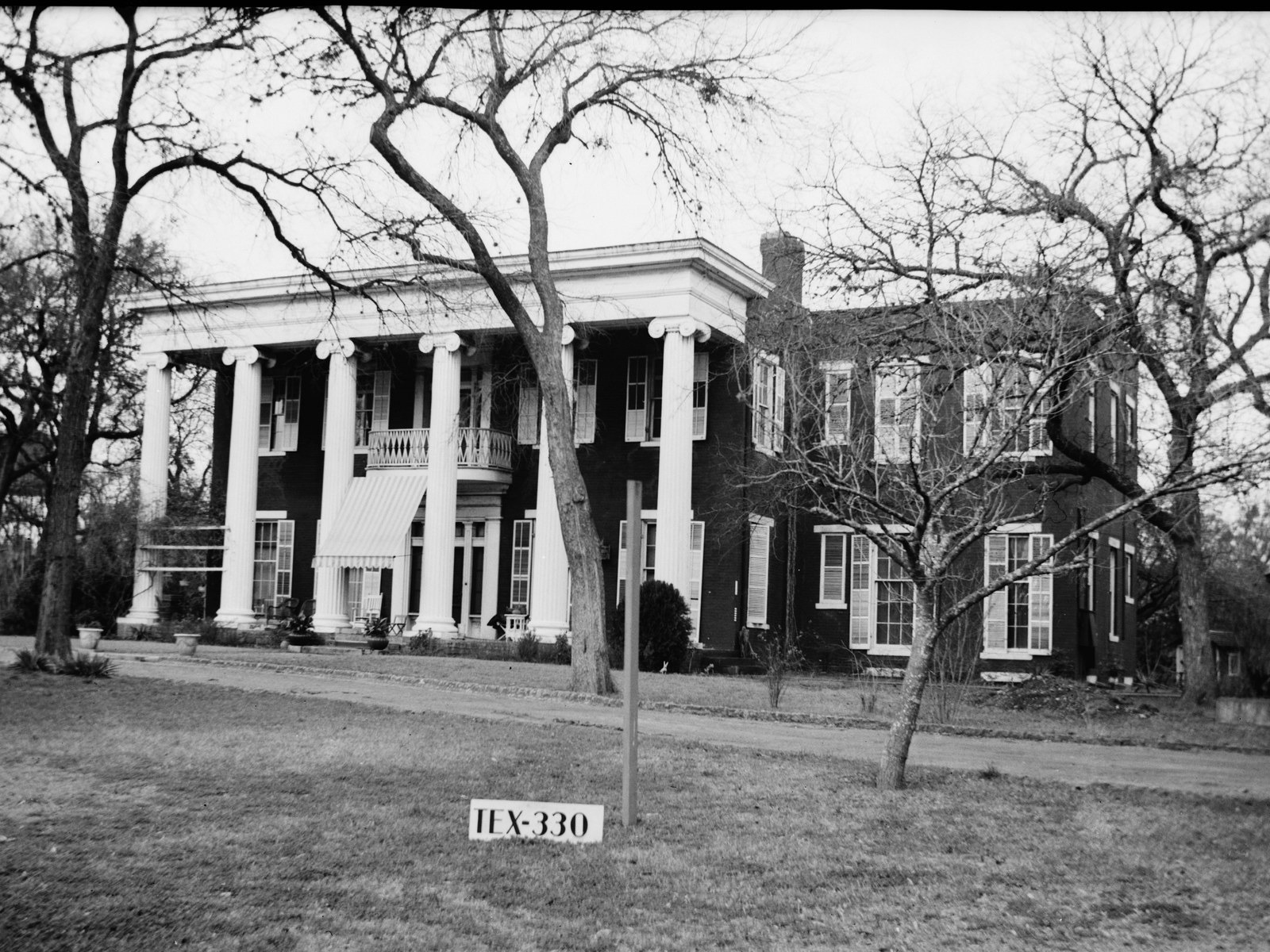
The Story
The Partner's Seat: J. Pinckney Henderson Succeeds Rusk, November 9, 1857
The Texas legislature had been in session one week when, on November 9, 1857, it sent James Pinckney Henderson to the Senate of the United States. The seat was empty because Thomas J. Rusk had died in it. The Handbook of Texas records the death plainly: despondent after his wife’s death and ill with a tumor at the base of his neck, Rusk took his own life at Nacogdoches on July 29, 1857. The Senate’s own roll gives the dates in two lines. Rusk, February 21, 1846, to July 29, 1857. Henderson, November 9, 1857, to June 4, 1858.
The two men had been partners. On February 25, 1841, Rusk and Henderson opened a law office at San Augustine that the Handbook calls “the most famous law firm in Texas of that day.” Rusk was a Mason of Milam Lodge No. 40 at Nacogdoches and had sat in the Houston convention of December 1837 that formed the Grand Lodge of Texas. Henderson was not a Mason. He would not be one for another eleven years, and the reason he gave is the heart of this week’s story.
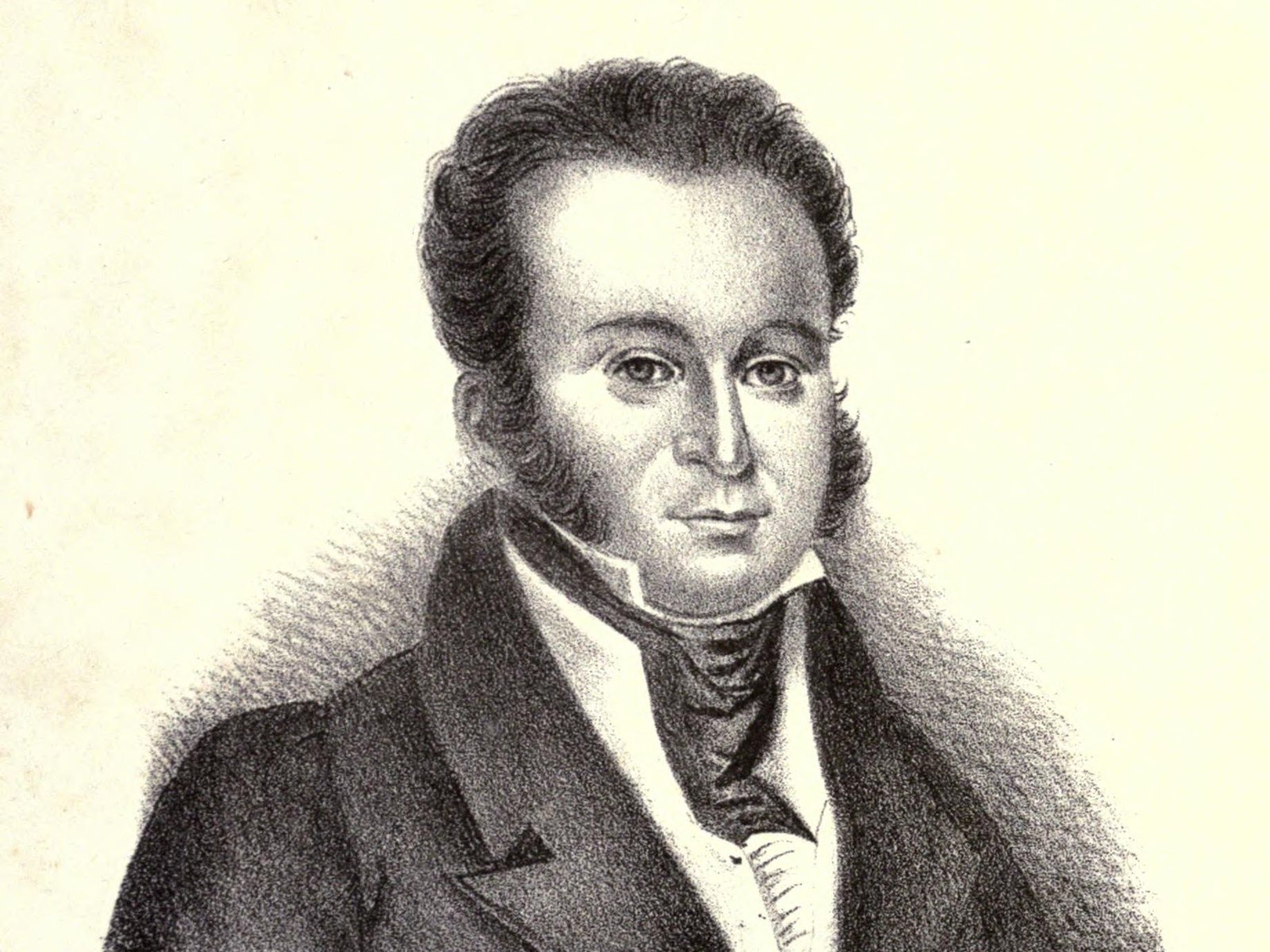
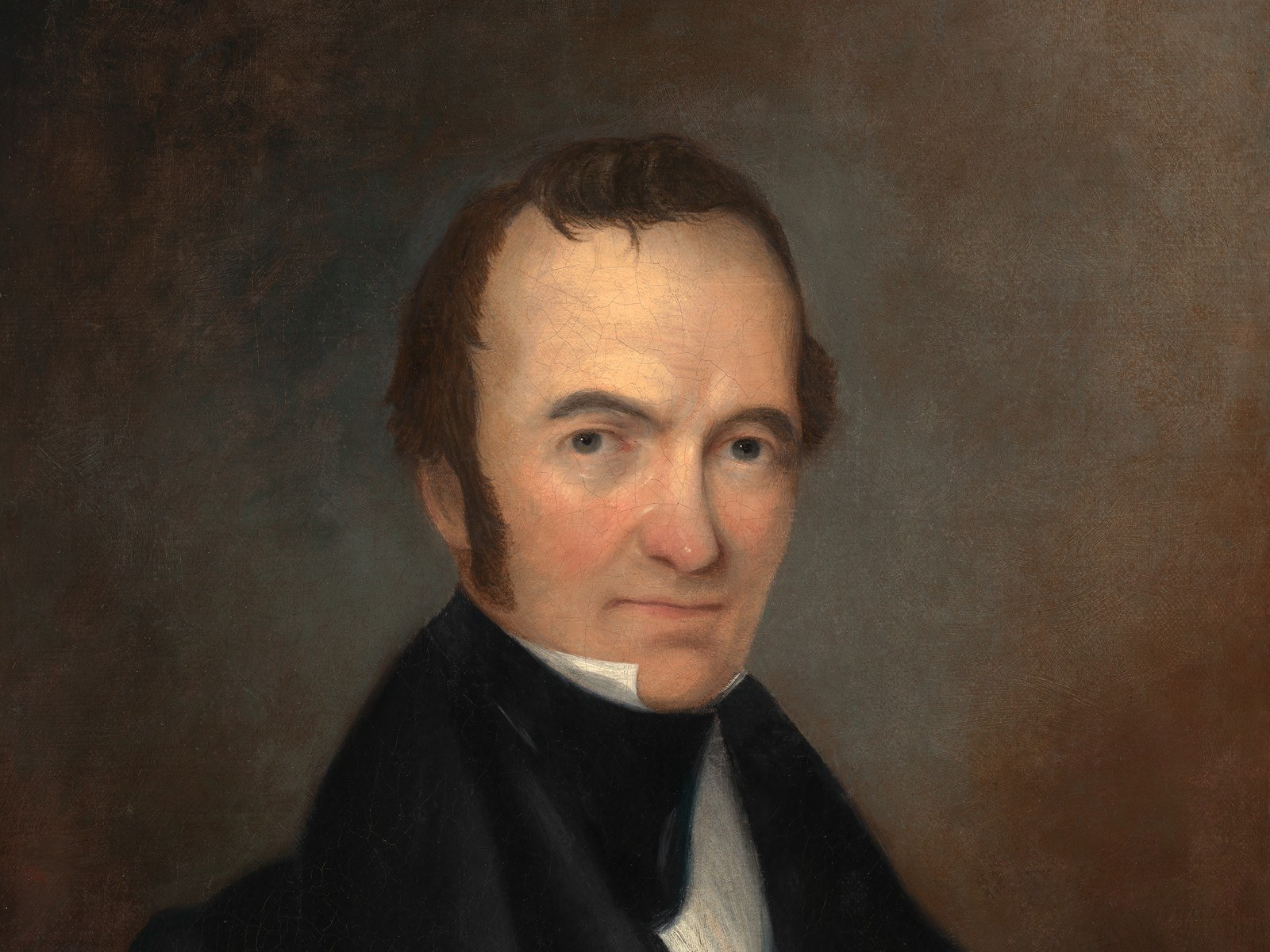
Begin with what he was. Born in Lincoln County, North Carolina, on March 31, 1808, he landed at Velasco on June 3, 1836, six weeks after San Jacinto, with a brigadier general’s commission and orders to raise men in the United States. By December he had succeeded Stephen F. Austin as secretary of state. In 1837 Sam Houston sent him to London and Paris, where he won the trade agreements that led to recognition of the Republic. He negotiated the annexation treaty of April 1844 and watched the United States Senate reject it. He sat in the Convention of 1845, was elected governor that November, and took the oath on February 19, 1846, when the new state government formally replaced the republic’s government. Texas had been admitted to the Union on December 29, 1845.
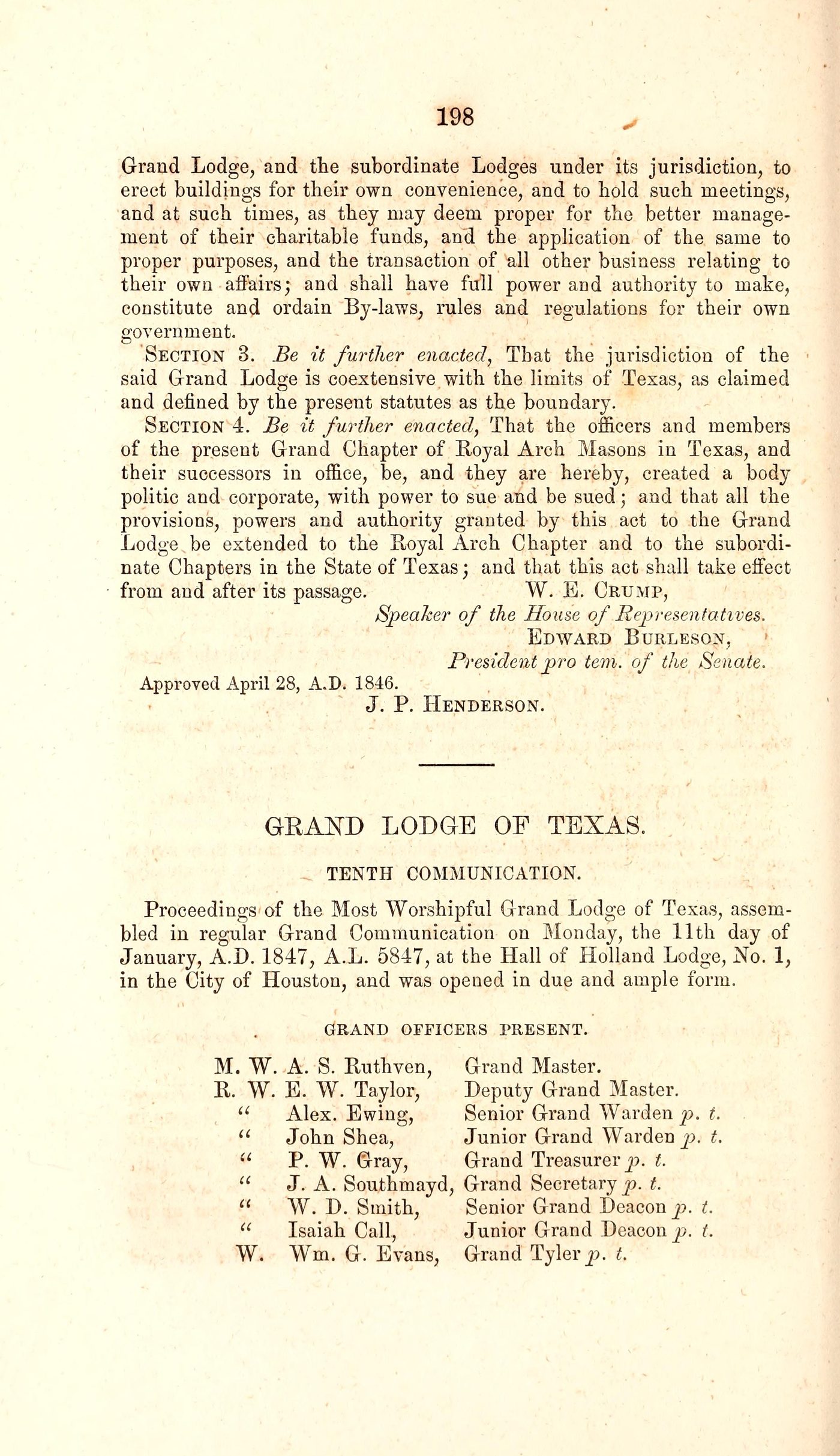
Ten weeks into the job he signed a short act. The Grand Lodge had been asking for one since the Republic. In January 1845 its select committee, with B. Gillespie in the chair, had told the brethren the plain truth: “without it, we can never have a permanent home or abiding-place. At present, if we wish to own real estate, to erect a hall, it has to be held in the name of some Brother, in trust; and, in cases of death, much difficulty often occurs.” The Republic ran out of years before its Congress acted. The first state legislature did. “An Act to incorporate the Society of Free Masons, composed of Lodges and Chapters” gave the Grand Lodge power “to hold property, both real and personal, for the purpose of erecting, endowing and maintaining an institution of learning,” capped at twenty-five thousand dollars, and made it lawful for “the subordinate Lodges under its jurisdiction, to erect buildings for their own convenience.” It was signed by W. E. Crump, Speaker, and Edward Burleson, president pro tem of the Senate, and at the foot of the page: “Approved April 28, A.D. 1846. J. P. Henderson.”
Three weeks later he was gone. The State Archives keep the letter he wrote the lieutenant governor on May 19, 1846: “I shall this day leave the seat of Government to take command of the Texian forces raised under the requisition of Gen’l Taylor, and shall move beyond the Rio Grande into Mexico.” He led the Second Texas Regiment at Monterrey, helped negotiate the city’s surrender, and was back at his desk by December 13. He declined a second term and went home to San Augustine in December 1847 to practice law.
That is where he found the Craft. The record is a speech. On August 21, 1858, San Augustine held obsequies for its dead senator, whose body lay in Washington, and the address was given by Franklin B. Sexton, a thirty-year-old lawyer who had read law in Henderson’s office and was already a working Mason. Forty years later the Texas State Historical Association printed the address entire in its Quarterly, noting that it had “become historical in itself.” Sexton began it: “Ladies, Fellow-Citizens, and Brother Masons.”
Near the end he turned to the brethren. “To my Masonic Brethren I have much pleasure in saying that our Brother Henderson was a devoted friend and patron of our Order. He was somewhat later in life in forming a connection with our Fraternity than is usual, but for this his reasons were entirely satisfactory.” Then the candor: “in the earlier days of Texas, owing to the promiscuous character of our inhabitants, it is lamentably true that many unworthy men became connected with us, with whom not only good men not Masons refused to associate, but with whom also Masons from the older States refused to fraternize. This evil time soon remedied. General Henderson was made a Master Mason in Red Land Lodge, No. 3, in December, 1852.” Sexton had been in the room: “There are present several Brothers who with me participated in the ceremonies of his initiation, passing and raising.” And the verdict: “to the day of his death was a zealous and faithful craftsman.”
A word on the number. The lodge Henderson joined had been chartered as Red Land Lodge No. 24; the Grand Secretary reported its charter to the communication of January 1846, the winter Henderson took office. The town’s first lodge, McFarland, chartered from Louisiana in 1837 and numbered 3 in Texas, had lapsed, and in January 1854 the Grand Lodge authorized Red Land to take the old number 3 in place of 24. That is the number Sexton used. In 1850 the lodge and its Royal Arch chapter had pledged thirty percent of their revenue to a school; the Masonic Institute of San Augustine opened in September 1851 and ran ten years. Henderson petitioned a lodge that was building a school with the kind of corporate power his own signature had made lawful.
Consider what Sexton’s explanation actually says. Henderson was forty-four, a former governor, a general, a diplomat. He had every social reason to join the fraternity that, by the Handbook’s count, supplied five of the six governors of Texas between 1846 and 1861, and he had declined through the whole of his public career. He waited, Sexton says, until the lodges of Texas had cleaned house. A man who signs your charter and then declines your door for six years is not flattering you. He is holding you to the standard you claim. When he finally knocked, the honor ran the other way, and Sexton, speaking over an empty tomb to a lodge that knew the story, was proud enough of it to say so aloud.
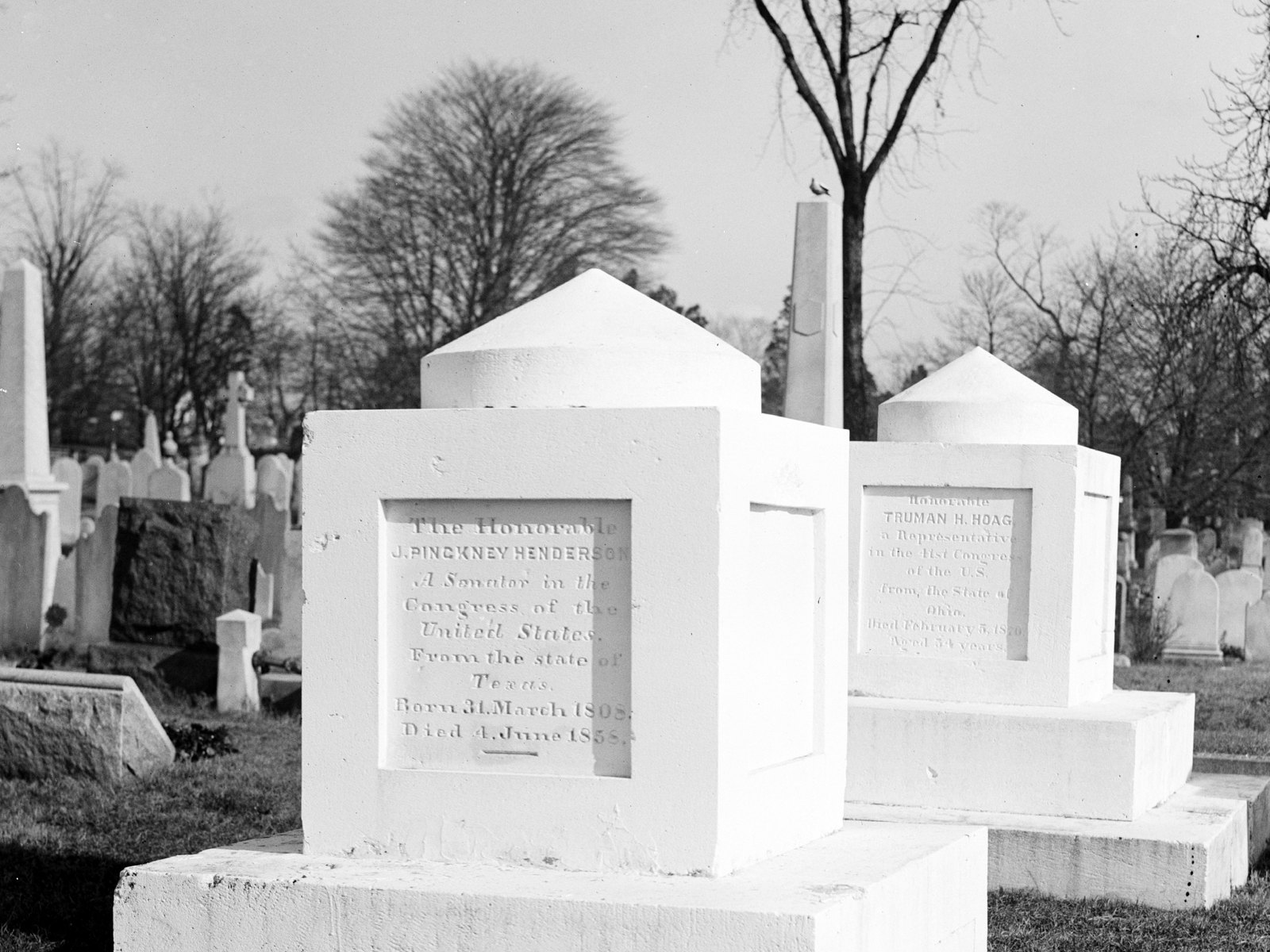
Henderson did go to Washington. The Congressional Globe for March 1, 1858, prints a Senate roll call on taking up the Kansas bill, thirty-two to twenty, and the yeas run “Hammond, Henderson, Houston, Hunter.” He was already dying. On June 5, 1858, Sam Houston rose to announce his death the day before. The old general, who had sent Henderson to Europe twenty-one years earlier, called him “a bold, enterprising spirit” and “a man of indomitable will,” and ended with Gray: “The paths of glory lead but to the grave.” The Senate resolved to wear crape on the left arm for the rest of the session. Houston was a Mason too, the man who had presided over the Houston convention that formed the Grand Lodge; the Senate’s tribute was a senator’s, and the lodge’s came in August. Henderson was buried in the Congressional Cemetery under a square white stone that names him a Senator from the State of Texas. In 1930 Texas brought him home to the State Cemetery at Austin. The Washington stone stands yet.
Here is what belongs to Johnson City Lodge No. 561. Our charter came from the Grand Lodge of Texas on December 16, 1882. The hall we meet in and the cemetery ground we keep are held by the lodge in its own name, not by some brother in trust until his death makes “much difficulty.” The first law in Texas that let a lodge hold property in its own name was the act of April 28, 1846, and the man who approved it was not yet one of us. He became one of us on his own time, for his own reasons, at a lodge that had made itself worth joining. That is the order the Craft prefers: the house in good repair first, and then the knock at the door.