This Week in Masonic History·August 24 to August 30, 2026
The Record We Keep: Hardin R. Runnels
Hardin Richard Runnels was born on August 30, 1820, and remains the only person who ever defeated Sam Houston at the polls. The Grand Lodge of Texas printed its own minutes for January 1852, and they place him in the room as the representative of Boston Lodge No. 69 — while the record of the same life holds thirty-nine enslaved people and a campaign to reopen the African slave trade. A week for keeping both halves of the book.
Hardin Richard Runnels was born in Mississippi on August 30, 1820, and Texas remembers him for a single sentence: he is the only person who ever beat Sam Houston in an election. The sentence is true, and it is also a trap. It reduces Runnels to a footnote on a larger man, which conveniently spares us the harder work — looking at what he did with the office once he had it, and at the fact that he took it as a Freemason, from another Freemason, in a state where the Craft had become part of the political weather itself.
This week the series can say something about him that it could not say before. The Grand Lodge of Texas printed its own proceedings, and the proceedings settle where Runnels sat.
His father died in Mississippi in 1839, and in 1842 the family came to Texas — a widowed mother, three brothers, and an uncle. They tried the Brazos first, then moved to Bowie County and put in a cotton plantation on the Red River. From 1847 to 1855 Runnels represented that far northeastern corner of the state in the Second through Fifth Legislatures, and in the Fifth he was Speaker of the House; afterward he served as lieutenant governor under Elisha M. Pease, the subject of last week’s feature and about as different a man as Texas produced in that generation. The plantation prospered. By 1860 the Handbook of Texas puts his property near $85,000 and the number of human beings he held in slavery at thirty-nine. Those facts sit in the same paragraph of the Handbook. They belong in the same paragraph here.
On Monday, January 19, 1852, the Grand Lodge of Ancient, Free and Accepted Masons of Texas met in the Masonic Hall of Austin Lodge No. 12, in the city of Austin, for its Fifteenth Grand Annual Communication. Grand Master William B. Ochiltree delivered his address and then named the standing committees required by the constitution; to the Committee on Grand Officers’ Reports — the committee that reads the Grand Master’s own year of work and passes judgment on it — he appointed Brothers John H. Herndon, B. E. Tarver, and H. R. Runnels. The next morning the Committee on Credentials reported which lodges were duly represented and by whom. Forty lodges answered. Holland Lodge No. 1, the mother lodge of Texas Masonry, sent Peter W. Gray, J. W. Henderson, and A. S. Ruthven. Directly beneath their names stands a line that has been in print since before the Civil War: Boston, No. 69 — H. R. Runnels.
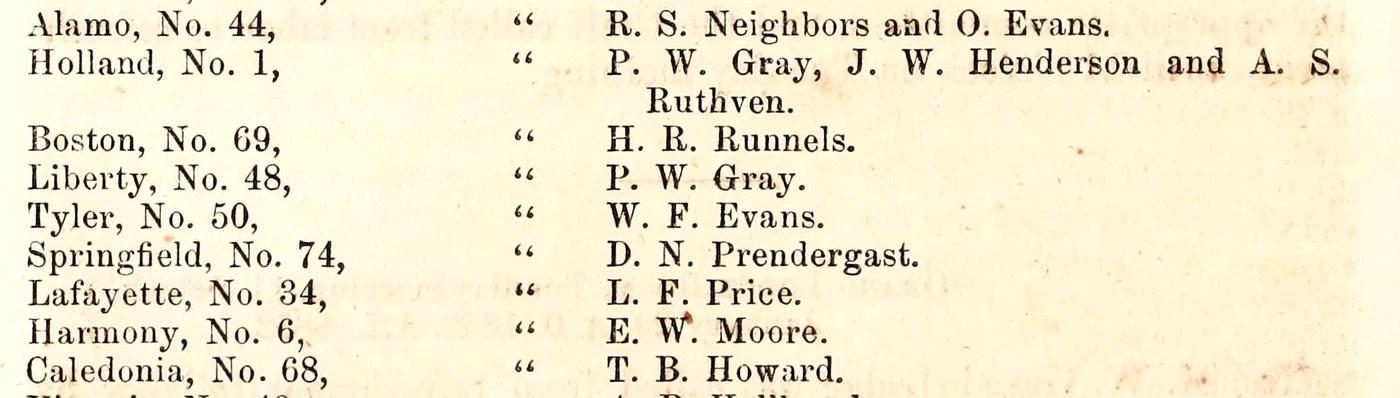
Boston was the seat of Bowie County, the town nearest his plantation, and its lodge carried a number that put it among the newer bodies on the Texas roll. Runnels was a sitting member of the Texas House when he answered that roll call; the legislature and the Grand Lodge were both in Austin that winter. The Handbook of Texas says only that he “belonged to St. John’s Masonic Lodge,” giving neither number nor town — and this series does not throw away what the Handbook says, because a man may affiliate more than once across fifty-three years. It is worth noting that a St. John’s Lodge No. 53 answered the same roll call that morning, represented by two other brethren entirely. What the Grand Lodge’s own minute book establishes is narrower and firmer than any summary: in January 1852, Hardin Runnels sat in the Grand Lodge of Texas for Boston Lodge No. 69, and the Grand Master trusted him to audit the year.
Five years later the state Democratic convention nominated him for governor on the eighth ballot. The party’s object was never Runnels; it was Houston, whose Senate record and apparent flirtation with the American — Know-Nothing — party had made him intolerable to the organization. Runnels was by common account a poor public speaker. He won anyway, 38,552 to 23,628.
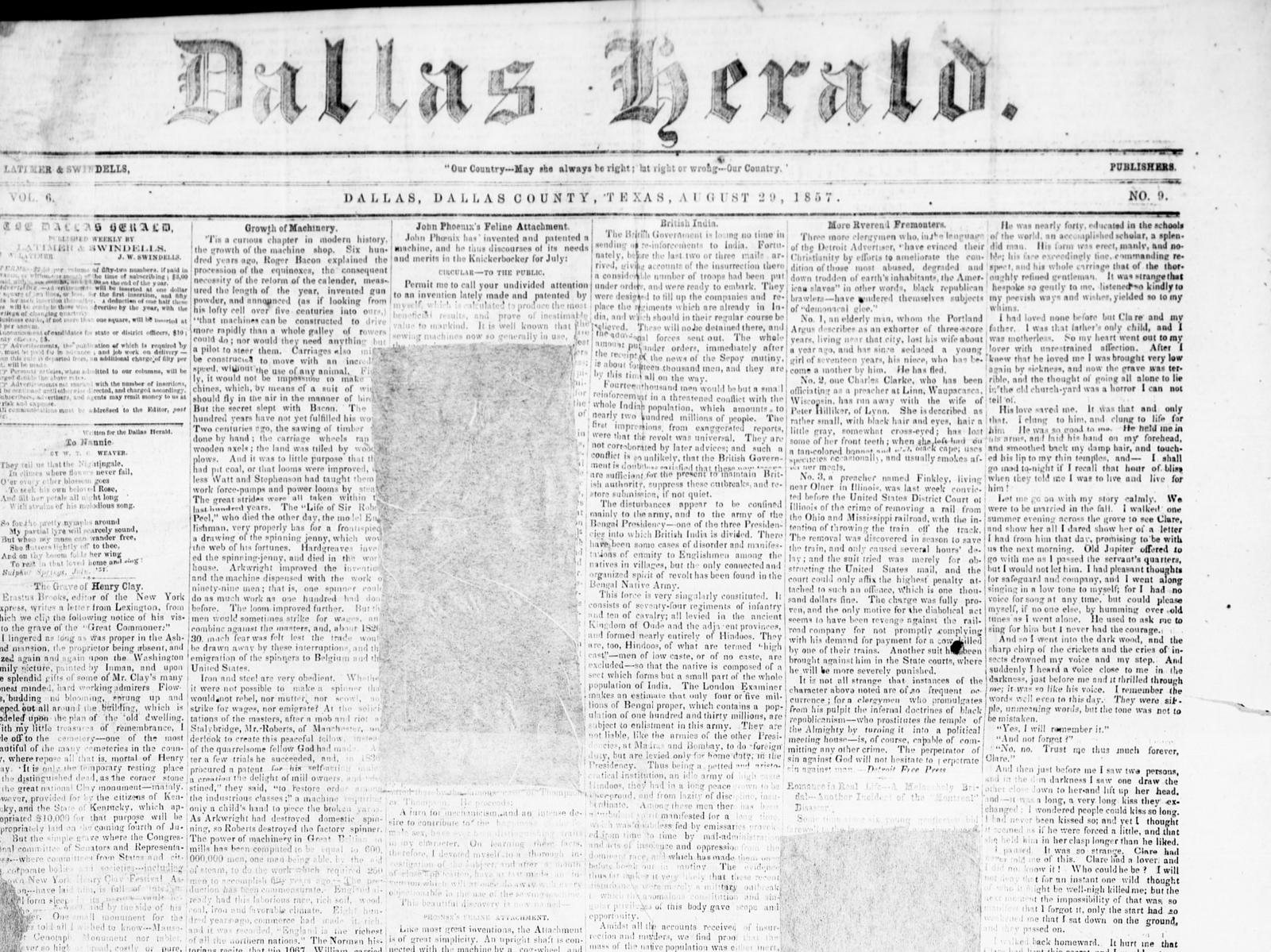
You can watch it happen in the newsprint. The Dallas Herald of Saturday, August 29, 1857 — this very week, a hundred and sixty-nine years ago — was still gathering returns three weeks after the vote: “The election returns continue to come in slowly. The lower and middle Rio Grande vote has been received since our last. As we anticipated, it rolls up like an avalanche for the democracy.” Cameron County, Runnels 766, Houston 95. Webb County, Runnels 389, Houston 8. The Herald — J. W. Latimer, editor — knew exactly what its party had pulled off, and joked about the militia titles Texans hung on their candidates: “It was hard enough to run Runnels, with the title of Colonel against one with the sounding prefix of General, but if we had pitted him with the insignificant title of Mr. he would have been nowhere.”
Then he governed, and the record is what it is. Runnels backed the unsuccessful effort to reopen the African slave trade, and he signed a law permitting free Black Texans to choose a master and enter slavery. He also approved funding toward the establishment of the University of Texas and a state geological survey. On the frontier he refused to keep permanent ranger battalions in the field, arguing that Indian defense was a federal bill to pay; in January 1858 the rangers took a new senior captain in John S. “Rip” Ford, and that spring they crossed north of the Red River and killed the Comanche chief Iron Jacket. When white Texans turned on the reservation Indians instead — seven of Choctaw Tom’s hunting party killed near Golconda in December 1858, several hundred men under John R. Baylor riding onto the Brazos reserve the following May — Runnels issued a proclamation warning Texans against hostilities toward the reservation people and sent Col. John Henry Brown with a hundred men to the frontier, while simultaneously petitioning Washington to remove the reservation altogether. Robert S. Neighbors marched them out on July 31, 1859. That is not a simple ledger, and flattening it in either direction would be a lie.
Houston came back in 1859 and beat him, 36,227 to 27,500, running on San Jacinto, on the frontier, and on the slave trade. But look at what the Dallas Herald had been flying over its own editorial column all along.
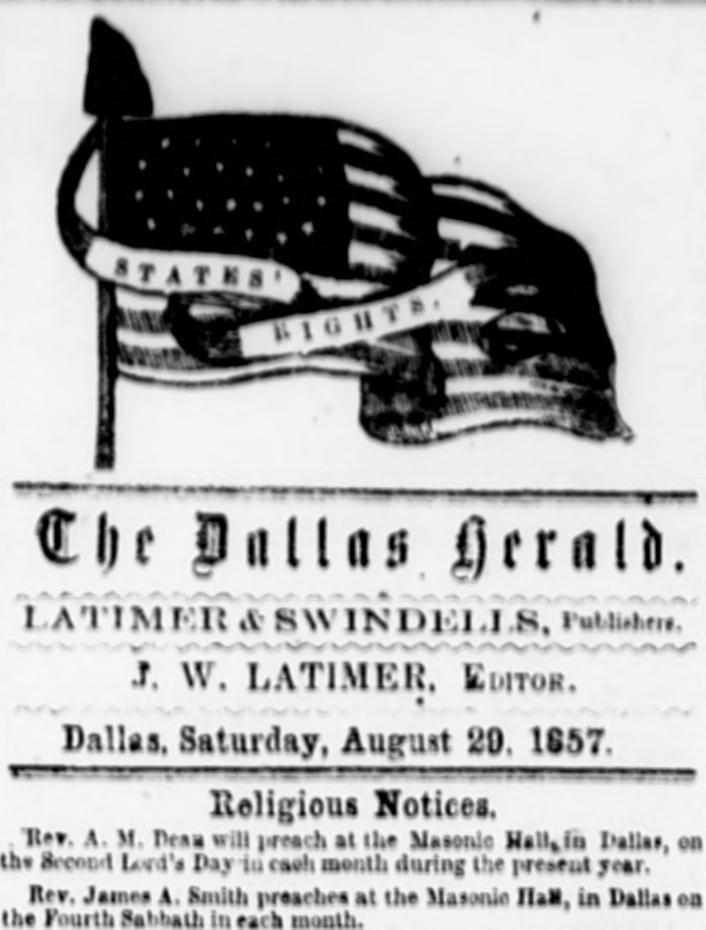
The Stars and Stripes with a “States’ Rights” ribbon knotted across it; and in the same column, a few lines down, notice that one minister would preach at the Masonic Hall in Dallas on the second Lord’s Day of each month and the Reverend James A. Smith on the fourth Sabbath. One column of newsprint, one Texas town, one week in 1857: the fever and the lodge room sharing a page.
Four years later the fever won. Houston refused to convene the legislature, so Oran M. Roberts and Rip Ford — both men this series has already met — printed calls in the newspapers and summoned a convention into being anyway. Runnels went as a delegate and a vigorous secessionist. On February 1, 1861, the ordinance passed 166 to 8; on March 5 the convention required every officeholder to swear loyalty to the Confederacy; Houston would not, and the delegates declared the governor’s office vacant. Texas Freemasonry in 1860 counted 226 lodges and some nine thousand members, and it would go on to issue dispensations for thirty-two traveling military lodges inside the armies. It could not do the one thing a sentimental reading of the Craft would expect of it. It could not put Houston and Runnels on the same side of that room. The lodge does not make a man good. It obliges him — and men fail obligations.
Runnels never married. He went home to Bowie County, built a Greek Revival house near Old Boston, and returned as a delegate to the Constitutional Convention of 1866, where he stood with the small band of irreconcilables. And then, on May 23, 1870, when the Texas Historical Society was organized at Houston, the men in that room elected him one of its vice presidents — the unreconstructed secessionist handed a share of responsibility for how Texas would remember itself. He died on Christmas Day, 1873. His people buried him in the family cemetery in Bowie County, and in 1929 the state exhumed him and laid him in the State Cemetery at Austin among the founders. Even the county that carries his name was never his: Runnels County, created February 1, 1858 while he sat in the governor’s chair, honors his uncle Hiram G. Runnels, who had died at Houston that December.
Johnson City Lodge No. 561 received its charter on December 16, 1882, nine years after Runnels was buried, and no brother of ours ever shook his hand. What we inherit from him is not a man. It is a duty. Freemasonry teaches that men meet upon the level, and the Craft has always known how easily that teaching curdles into a compliment we pay ourselves. Runnels is the proof. He sat in a Grand Lodge in Austin in January 1852 beside men who would spend 1861 on the far side of the question from him, and he held thirty-nine people in bondage the entire time he was doing it. Both halves are in the record. A lodge that keeps only the admirable half is not keeping a record; it is keeping a legend, and a legend cannot instruct anybody. The Grand Lodge of Texas printed that January morning exactly as it occurred, names and all, without any idea what those names would come to mean. That is the discipline. In Blanco County our own minute books do the same small honest thing every month — they say who was present and what was done — and their worth to whoever opens them in 2170 depends entirely on whether we told the truth in them. Hardin Runnels has his place in this series not because we admire him, but because we are obliged to be exact about him. Accuracy is the first charity a Mason owes the dead.
Listen to This Story
6:30Read it here. Hear it anywhere.
Take the Story With You
Never miss a week.
Subscribe once and each new Texas Masonic history episode will arrive automatically in your podcast app.