This Week in Masonic History·September 14 to September 20, 2026
The Work of Younger Men: William Marsh Rice
On the night of September 23, 1900, William Marsh Rice, a Houston merchant who had made himself one of the richest men in Texas, was chloroformed in his sleep in a New York apartment by his valet, on the instructions of a lawyer who had forged a will to take his fortune. The fortune was already promised. Nine years earlier Rice had chartered an institute in Houston, put the money in trust, and left the building of it, in his own phrase, to younger men. The trustees held; the murderers were caught; and on the twelfth anniversary of his death the Rice Institute opened its doors. A week about a Mason who drew the plan and never saw the building, and about what it means to work for something you will not live to finish.

On the evening of Sunday, September 23, 1900, an eighty-four-year-old man went to bed early in his apartment at 500 Madison Avenue, New York. He had been weak for days. His valet, Charles F. Jones, waited until he was asleep, took a small sponge the old man used for cleaning his clothes, folded it into a towel pinned into the shape of a cone, poured two ounces of chloroform into it, set the cone over his face, and left the room. Thirty minutes later Jones came back and found that William Marsh Rice, the Houston merchant who had become one of the richest men in Texas, was dead.
The telegram that reached Houston the next morning gave the cause as “old age, weak heart.” The Houston Daily Post printed the news on Tuesday under the headline “William M. Rice Dead,” reported that “his demise was due chiefly to old age,” and called him “one of the pioneer citizens of Houston.” The second statement was true. The first was a lie.
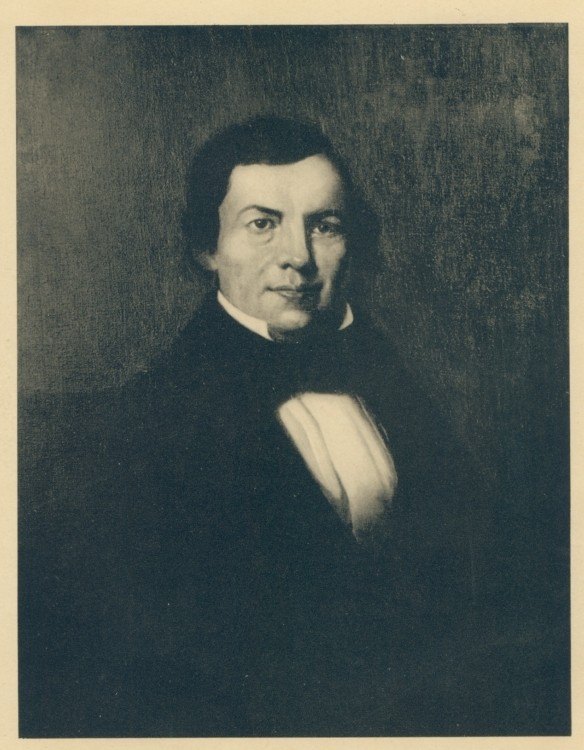
Rice had come to Texas in October 1838, a twenty-two-year-old from Springfield, Massachusetts, to find “shanties and stumps about the street” of a town two years old. On April 22, 1839, he agreed to furnish the liquors for the bar of the Milam House, for three dollars a day and board, a detail that Andrew Forest Muir, the Rice University historian who spent the last twelve years of his life on Rice’s biography, records with relish, since the man never smoked and never drank anything as stimulating as coffee. Fourteen months later Houston issued him a first-class mercantile license. By 1860 the census carried him at three-quarters of a million dollars, which may have made him the second-richest man in Texas.
He was, the Handbook of Texas records, “an Odd Fellow, a Mason, and an Episcopalian.” Muir says the same, in the same breath as the petit juries, the grand jury, and Liberty Fire Company No. 2, the ordinary civic furniture of a merchant’s life in a young city. No institutional record this series has found names his lodge, and this series will not guess at it. What the record does show is a man who sat as an alderman, signed letters asking Sam Houston to come and speak, and who, long before he thought of a university, sat on the boards of the Houston Academy, a free school, and the Texas Medical College in the 1850s. He was a joiner, in the plain Texas sense, and the things he joined were the ones that outlast their members.
Then, in his seventies, he did the most far-reaching thing of his life, and did it the way a careful man does anything: on paper, in advance, with witnesses.
On May 13, 1891, Rice signed a deed of indenture handing a two-hundred-thousand-dollar interest-bearing note to seven trustees: himself, his brother Frederick, his attorney James A. Baker, and four Houston businessmen. Six days later the charter of the William M. Rice Institute for the Advancement of Literature, Science and Art was filed at Austin. The endowment was to build “a thorough polytechnic school, for males and females,” and its instruction was “to be free.” Muir is honest that the indenture, like the city that produced it, limited its benefit to white residents; the university has since said so itself. The note was payable on Rice’s death. And one clause is unmistakably the founder’s own voice: “should there at any time be a difference of opinion” between him and the trustees, “the decision of the said party of the first part shall control.” While he lived, the plan was his. When he died, it would be theirs.
He would not build. In 1895 he and the trustee Emanuel Raphael drove a rented buggy out to a nursery and bought sixty-two young elm trees for the six-acre lot on Louisiana Street, and Raphael fenced the land and hired a caretaker to guard them. That was as far as William Marsh Rice would go. Making money, he said, was what he did best; putting up buildings “could be better done by younger men when the time came.” In 1896 he made a will naming the Institute residuary legatee of everything he had, and told a visiting minister that “the Institute will have a great deal of money, very much more than you think.”
That will is what the plot was aimed at. Albert T. Patrick, a Texas lawyer who had left Galveston under threat of disbarment and was working in New York for the other side in the litigation over Rice’s late wife’s will, cultivated the valet, drafted a new will dated June 30, 1900, that made Patrick the residuary legatee, forged the signature, and had it witnessed. The murder was only the last step, and it nearly worked. The next morning a check for twenty-five thousand dollars in Patrick’s favor reached Rice’s bank, and only when a cashier who disliked the signature telephoned the apartment did the valet admit that Mr. Rice was dead. Patrick had already had the body embalmed and was pressing for cremation.
By afternoon Baker had two telegrams on his desk in Houston: the valet’s, and one from the bank that read, “Mr. Rice died last night under very suspicious circumstances.” He and Frederick Rice wired New York to stop the cremation and took the train. Jones confessed, changed his story, twice tried to kill himself, and confessed again. Patrick was convicted of murder on March 26, 1902, and sentenced to the electric chair; the sentence was commuted to life in December 1906, and on November 27, 1912, the governor of New York gave him a full pardon. He went to Oklahoma and sold automobiles.
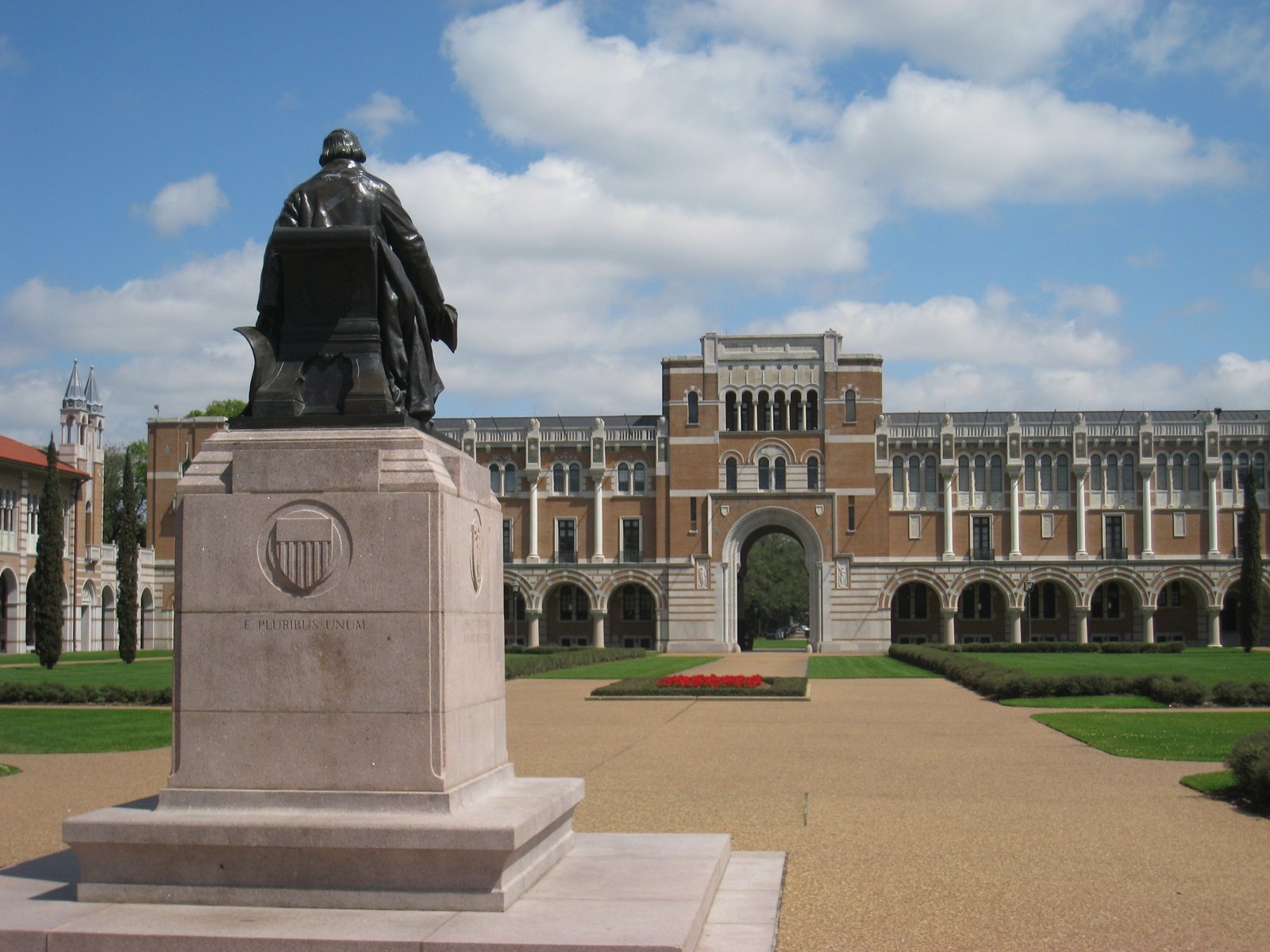
The trustees, meanwhile, did the unglamorous thing the founder had built them to do. They fought the forged will through the courts, settled the claims of the widow’s heirs, and on April 29, 1904, took possession of an estate that Muir sets at $4,631,259.08. They went to Princeton and found Edgar Odell Lovett, and gave up the lot on Louisiana Street for three hundred acres of prairie at the end of Main Street. On September 23, 1912, twelve years to the day after the chloroform, the Rice Institute opened its doors to seventy-seven students and a faculty of about a dozen; the formal inauguration followed on October 10 through 12. In June 1930 the trustees dedicated John Angel’s bronze of the founder in the middle of the academic court and placed his ashes beneath it, where they remained until 2024, when the statue was moved and the ashes were reinterred in the family plot at Glenwood Cemetery.
There is one more building in this story, and it belongs to Masonry. In November 1837 Holland Lodge, scattered by the war and carrying its charter in Anson Jones’s saddlebags, reopened in the improvised capitol of the Republic at Main and Texas Avenue in Houston, and that December, the state’s marker records, it joined Milam Lodge and McFarland Lodge in organizing the Grand Lodge of Texas. The frame capitol became a boarding house; in 1881 Rice’s old partner Abraham Groesbeeck tore it down and put up a brick hotel; and on January 23, 1886, at a tax sale, the Capitol Hotel passed into William Marsh Rice’s hands. He lived in it when he was in Houston. When he died it reverted to the Institute, whose trustees promptly petitioned to rename it the Rice Hotel. The ground on which Texas Masonry reconvened became, for a time, the property of a Texas Mason, and then of the school he left behind.
Johnson City Lodge No. 561 received its charter from that Grand Lodge on December 16, 1882, nine years before Rice filed his. The two documents are the same kind of instrument: a plan drawn by men who understand that they will not be present for most of what it does. The brethren who petitioned for a lodge in Blanco County were binding men not yet born to a set of obligations, and trusting those men to keep them. Masonry teaches this openly. The apprentice is set to work on a plan he did not draw; the master draws plans for hands that are not his own; and the whole Craft is a lesson in laboring on a building whose completion you are not promised to see. William Marsh Rice lived that lesson to the letter, down to the sixty-two elm trees on an empty lot. He never saw a building. He saw to it that there would be one, and that the men he chose would be strong enough to hold it when the worst thing happened. The worst thing happened. They held. That is what a good plan, and a good lodge, is for.
Listen to This Story
6:46Read it here. Hear it anywhere.
Take the Story With You
Never miss a week.
Subscribe once and each new Texas Masonic history episode will arrive automatically in your podcast app.