This Week in Masonic History·September 7 to September 13, 2026
The Unloved Founder: Samuel May Williams Dies at Galveston
On September 13, 1858, Samuel May Williams died in his house on Avenue P in Galveston, and the Knights Templars buried him. Texas had needed him for thirty-five years and had never much liked him: Austin's clerk and translator, the man whose credit armed the Revolution, a land speculator proscribed by Mexico, and at the end the president of the only chartered bank in the state, sued through the courts for the last six years of his life. The lodge kept a different ledger. In 1839 it made him Grand Master while he was still a Junior Warden, and in 1858 it carried him to his grave. A week about the men who keep the books, and about the one institution that counted the work.

On September 13, 1858, after a short illness his physician could only describe as “a general debility — a giving way mentally and physically,” Samuel May Williams died in his house on the western edge of Galveston. He was sixty-two. The Handbook of Texas closes his life in one sentence: he “was buried by the Knights Templars whose chapter he had founded.”
That sentence takes some explaining. Texas needed Samuel May Williams for thirty-five years and never much liked him. Why the Craft buried a man his country had stopped thanking is the work of this week.
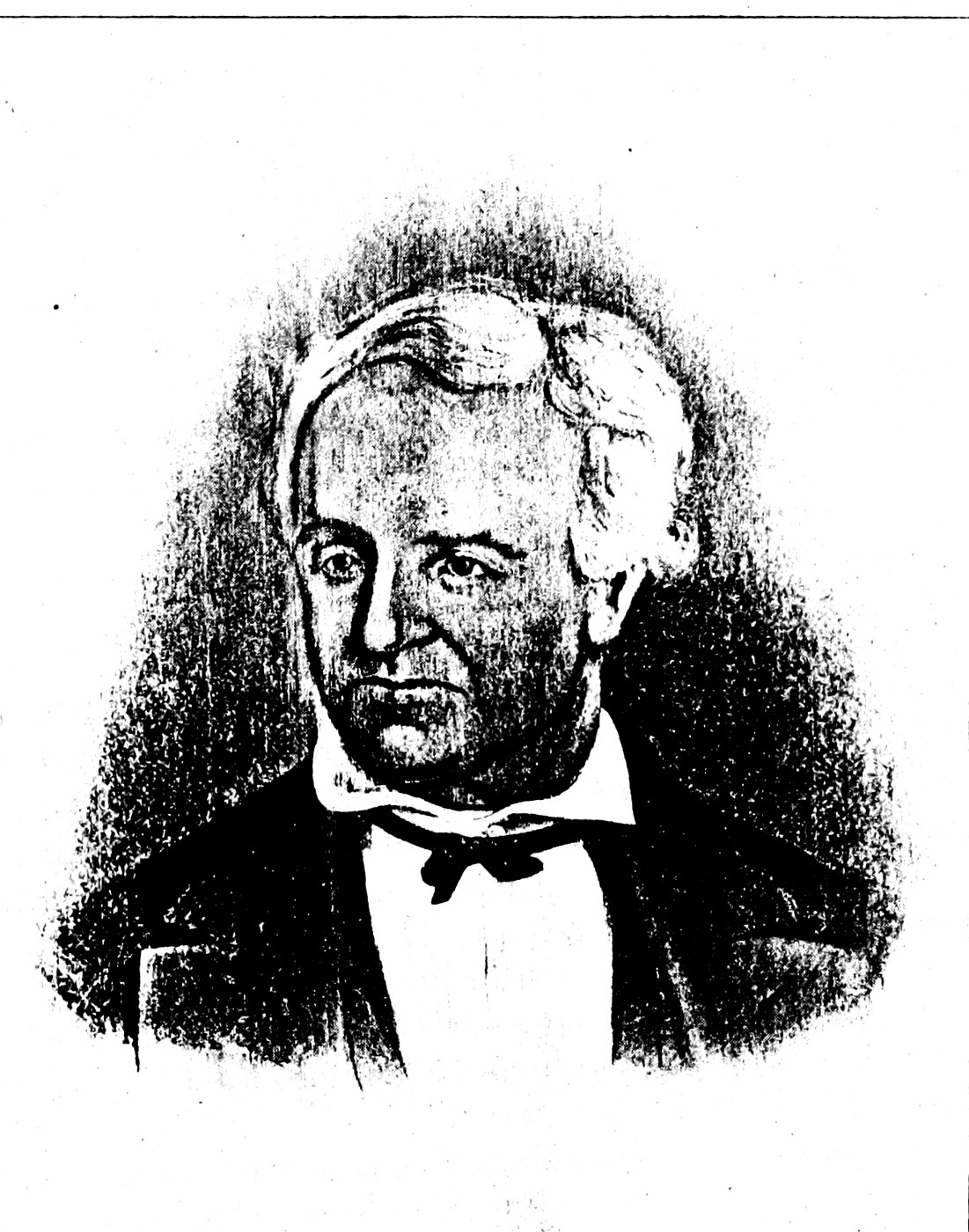
He was born in Providence, Rhode Island, on October 4, 1795, apprenticed to a Baltimore uncle, learned Spanish in Buenos Aires, and reached Texas in 1822. For the next thirteen years he was Stephen F. Austin’s clerk, translator, and lieutenant: the man who wrote the deeds, kept the records, and ran the colony while the empresario was away. It is the sort of work that makes a country function and makes no one famous.
Then, in 1835, he became notorious. At the Monclova legislature that spring he contracted for two of the four-hundred-league land grants the state was selling to raise money against Santa Anna, and the Handbook records the result: “He and six others were proscribed as revolutionaries, but he escaped arrest by going to the United States.” Mexico wanted him in irons. The word the Handbook chooses for his standing among Texans that year is “notoriety.” He went east anyway, to New York, carrying letters of introduction from Austin, and when word reached him that fighting had begun, he did the thing he was best at. He borrowed. On the private credit of McKinney and Williams he bought arms and supplies for an army that had no treasury; the state’s historical marker puts the sum at ninety-nine thousand dollars, and the Handbook adds that the Republic never repaid it in full.
Notice what else happened on that journey. The Grand Royal Arch Chapter of Texas records that Williams was exalted a Royal Arch Mason in Jerusalem Chapter No. 8 in New York City on November 25, 1835; the published roll of Independent Royal Arch Lodge No. 2 of New York, a craft lodge despite its name, carries “Williams, Samuel M.” among its members. Fourteen days after his exaltation, on December 9, 1835, the General Grand Chapter of the United States granted a charter for San Felipe de Austin Chapter No. 1, the first Royal Arch chapter in Texas, and the Grand Chapter’s own roll lists Williams as its High Priest for 1835. A proscribed man buying muskets on credit for a country that did not yet exist, he secured in the same weeks a Texas charter for a chapter that could not meet, because the Revolution was about to sweep over the town it was named for. It never opened at San Felipe. It opened at Galveston on June 2, 1840, and the calendar of his papers records the dues of that chapter, “payable to Williams, Treasurer,” that summer.
McKinney and Williams moved to Galveston in 1838, and the Lewis Publishing history of 1895 credits the firm with the town’s first wharf and first warehouse. He represented Galveston County in the Republic’s Congress in 1839. He was an officer of Harmony Lodge No. 6 from its first months under dispensation. The lodge was still working under that dispensation when the Grand Lodge of the Republic of Texas met at Austin on December 15, 1839, and its printed proceedings record what happened next with almost no adornment. Two men were nominated for Grand Master: the sitting Grand Master, Branch T. Archer, “constitutionally,” and “the W. S. M. Williams, Junior Warden of Harmony Lodge, No. 6, at Galveston.” The ballot “resulted in the election of Bro. S. M. Williams, he having received 24 votes.” Archer installed him that afternoon and “surrendered to him the Chair and the Gavel.”
Read that again. The Grand Lodge of Texas, two years old, passed over its own Grand Master, a veteran of Gonzales and the elected chairman of the Consultation, for the Junior Warden of a lodge that did not yet hold a charter. On January 30, 1840, the Grand Lodge met again at Austin with “Bro. S. M. Williams, M. W. Grand Master, in Chair,” and in the days that followed it granted the charter of Harmony Lodge No. 6, with Williams sitting at the same time as the lodge’s Worshipful Master. He presided until Anthony Butler was installed in December 1840. The Grand Lodge of Texas lists him today as its Grand Master for 1840, parent lodge Harmony No. 6.
The Royal Arch kept electing him too. He was High Priest of San Felipe de Austin Chapter in 1840, 1841, and 1842, and again in 1847 and 1848. When the first Grand Chapter of Texas, formed at Austin in 1841, dissolved itself in 1849 to end a jurisdictional quarrel with the General Grand Chapter, the companions who re-formed it at Galveston on December 30, 1850 chose Williams as Most Excellent Grand High Priest. A June 1848 letter in his papers from E. B. Nichols at Houston reports that the brethren there had “made eight Templars” and asks for Williams’s attendance. In June 1849 Harmony Lodge unanimously asked him to be “Orator of the Day” for Saint John’s Day, and a committee wrote afterward to thank him for an “eloquent and instructive address.”
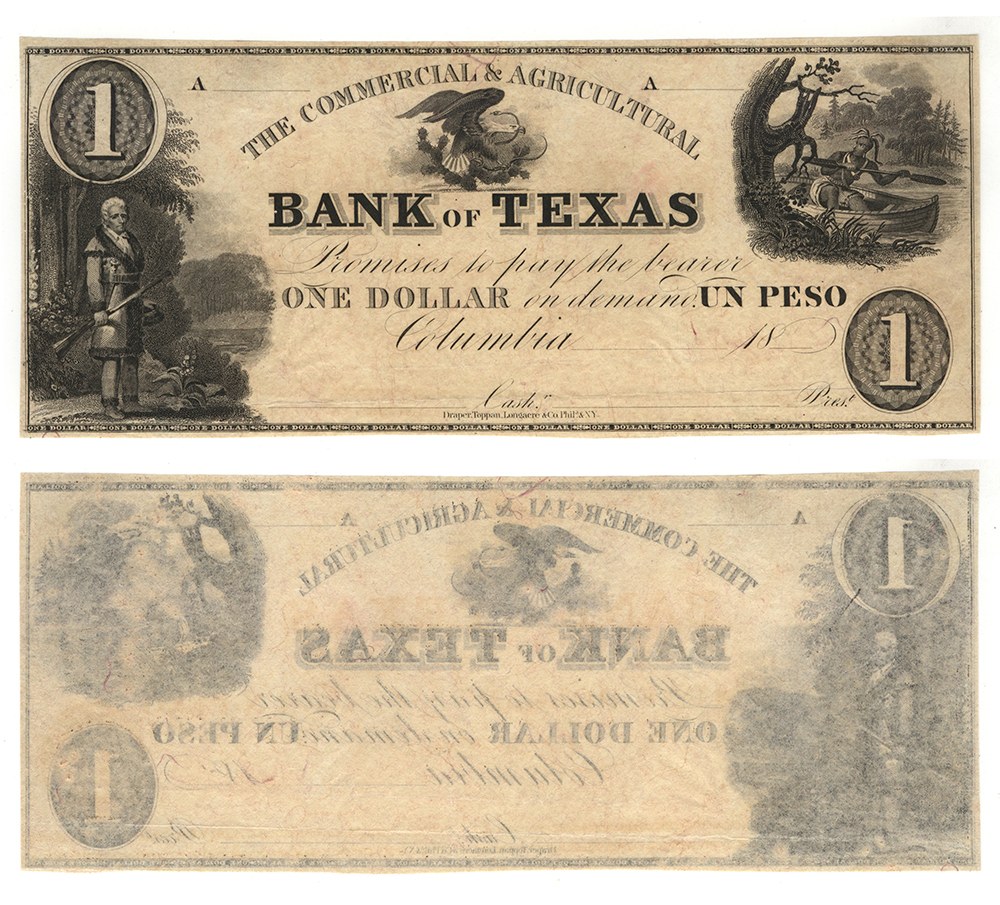
Then he built the thing that finished him. Williams had carried a Mexican bank charter since 1835, and in 1841 the Republic’s Congress gave the firm “special permission” to issue paper money. The Commercial and Agricultural Bank finally opened at Galveston on December 30, 1847, with Williams as president: the first incorporated bank in Texas, and, as Ruth G. Nichols wrote, the only bank of issue in the state before the close of the Civil War. But the Constitution of 1845 had forbidden banks outright, and litigation against the charter began in 1852. The Supreme Court sustained the bank that year; the suits kept coming. Nichols, who arranged his papers for the Rosenberg Library, wrote that the bank “seems to have engendered more vexations, anxieties, and bitterness than any other experience of Williams’ life,” and quoted his own phrase for it: “prosecutions and persecutions.” In January 1857 one of his sons wrote to the other: “if there is anything I have detested, it has been the Bank’s connection with its influence on our family interests and quietude.” He did not give it up. He died in September 1858 with the case still pending, and in 1859 the court closed the bank for good.
Three days after his death his son William wrote to his brother of their father’s death and of “the honors paid him by friends and masonic brothers.” That is the Templar burial, seen from inside the house. The 1895 volume that printed his portrait opened its sketch of him with something close to an accusation: his “name is hardly known to this generation,” it said, an “apt illustration how much more enduring military glory is than civic honors.” It closed by naming the one thing about him that had not been forgotten. “He was a prominent Mason, a pioneer member of the order in Texas, making the principles and practices of the craft his religion.”
Johnson City Lodge No. 561 knows this man, because every lodge has one. He is the brother who keeps the minutes, collects the dues, reads the fine print, and finds the money when there is none, and whose name is on no monument. Texas proscribed Williams, sued him for six years, and forgot him in a generation. The Craft elected a Junior Warden Grand Master over a sitting Grand Master, and it did so, as far as the record shows, for no reason but the quality of his work. And when the time came, it walked him to the Episcopal cemetery. The public ledger and the Masonic ledger are not the same book. Ours is the one in which faithful labor, quietly done, is entered as the highest honor we have. Samuel May Williams kept the books of Texas for thirty-five years, and it was the lodge, in the end, that kept his.
Listen to This Story
6:08Read it here. Hear it anywhere.
Take the Story With You
Never miss a week.
Subscribe once and each new Texas Masonic history episode will arrive automatically in your podcast app.