The Story
The Keeper of the Record: Price Daniel and the Archive of Texas
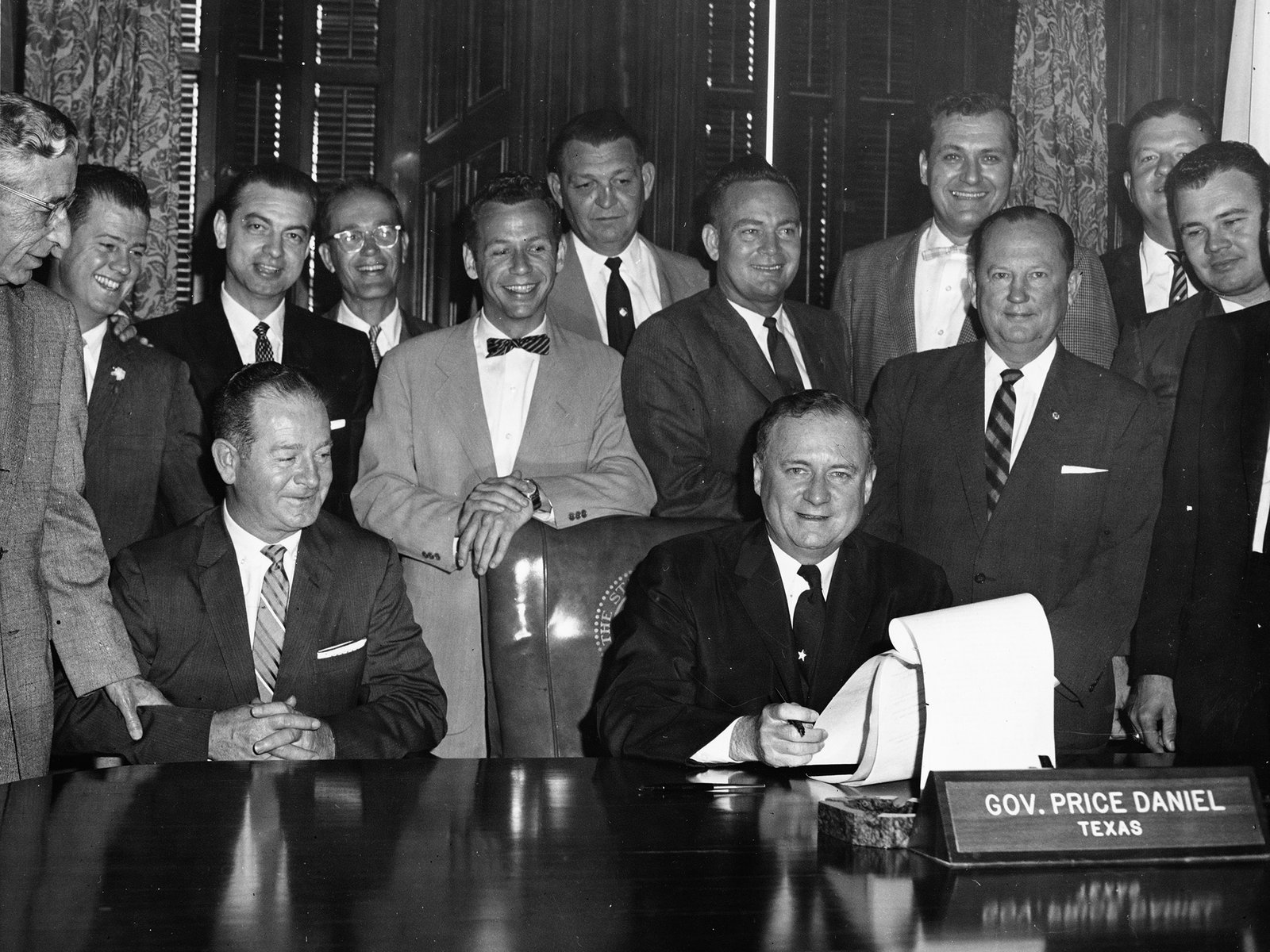
In the summer of 1961 the governor of Texas was photographed doing a porter’s work. On July 27, at the new building rising in the Capitol complex in Austin, Price Daniel helped unload the first box of material to be stored there. The Texas State Library preserves the picture, and its caption explains why the governor had his sleeves rolled up: he “was a devoted student of history and directed enormous energy towards establishing a new home for the Texas State Library and Archives, virtually designing the building himself.” The Handbook of Texas says the same, adding that the papers it would house “had been subject to neglect.”
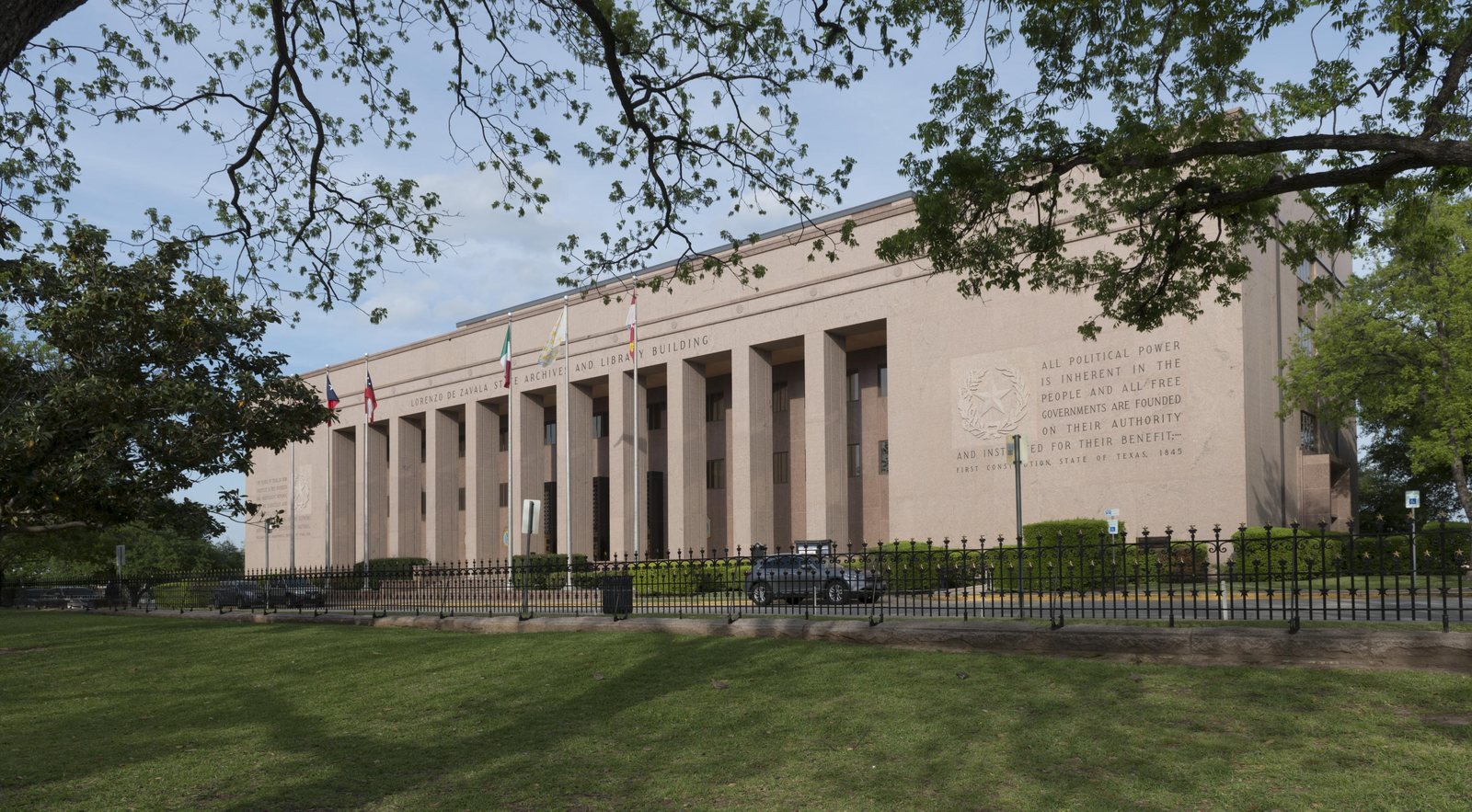
The building opened on April 10, 1962, when Daniel and his wife Jean, a great-great-granddaughter of Sam Houston, cut the ribbon. Its name is one this series knows well. It is the Lorenzo de Zavala State Archives and Library Building, and it still stands just east of the Capitol, holding the archives of the state.
Daniel was born on October 10, 1910, in Dayton, Liberty County. William Denslow’s 10,000 Famous Freemasons, published by the Missouri Lodge of Research in 1957, records that before he finished college he worked as a reporter for the Fort Worth Star-Telegram and the Waco News-Tribune, and that from 1939 he was co-publisher of the Liberty Vindicator. He took his law degree at Baylor in 1932 and opened a practice in Liberty. He went to the Texas House in 1939, and in 1943 his colleagues elected him speaker without a dissenting vote. Then he enlisted in the army as a private, came out of officer candidate school a judge advocate, and served in the Pacific and in Japan.
In Liberty he was also a Mason, and not a passive one. Denslow’s entry reads: “Past master of Liberty Lodge No. 48, Liberty, Texas; member of chapter, council and commandery and KCCH in AASR.” He had presided in the East of one of the older lodges in the state. The Texas Historical Commission’s marker at the lodge records that Liberty Lodge was organized in 1848 and chartered the next year, that it lost its hall to fire in 1858 and again in 1909, and that its members over the years included veterans of the Texas Revolution, legislators, Supreme Court justices, school trustees, “and one governor of Texas.” Twice the lodge saw its building burn. It is the kind of place that learns what a record is worth.
Elected attorney general in 1946, the youngest in the country, Daniel made the record his weapon. The Handbook credits him with more than five thousand lawsuits, two thousand bills drafted for the legislature, and more land and money claims successfully defended than any attorney general before him. His great case was the tidelands. When the federal government claimed the oil-rich submerged lands off the Gulf coast, Daniel argued that they belonged to Texas because of an agreement in the terms of the state’s annexation, which is to say he went back to the documents of 1845 and held the nation to them. He lost in the Supreme Court, broke with his party, and carried the fight into the Senate, where he helped write the bill President Eisenhower signed on May 22, 1953. When the Justice Department then tried to cut the Texas boundary from three leagues to three miles, the state defended it, and on June 1, 1960, with Daniel in the governor’s chair, it won. The Handbook entry on the controversy, which Daniel wrote himself, reports that by 1987 the Permanent School Fund had received nearly two billion dollars from those lands. Generations of Texas schoolchildren had been taught, in part, on the strength of an argument from the terms of annexation.
A history that means to be trusted has to keep the rest of the file, and Daniel’s file has hard pages. The Handbook’s biography of Daniel names, among his three best-known crusades as attorney general, “the defense of the University of Texas law school in its refusal to admit Heman Marion Sweatt,” a Black postal clerk who met every requirement for admission but one. In 1950 the Supreme Court ruled that Texas had to admit him, and Sweatt enrolled that fall. Six years later, on March 12, 1956, the Congressional Record printed the “Declaration of Constitutional Principles,” the Southern Manifesto against the Court’s school desegregation decisions. Among the senators’ names beneath it is PRICE DANIEL. Those pages are in the archive too, in the same national and state record he spent his life defending. That is not a failure of the archive. It is the archive doing its work.
He came home to be governor, saying he would “rather be governor of Texas than President of the United States,” and served three terms. The Handbook counts 131 of his 151 major proposals enacted: highways, prison reform, water conservation, higher teachers’ salaries, improved care for the mentally impaired. When the legislature passed a sales tax over his objection in 1961, he let it become law without his signature rather than let the state go broke, and clerks began ringing up purchases with a request for “a penny for Price.” He lost his bid for a fourth term in 1962. President Lyndon Johnson brought him to Washington in 1967 to head the Office of Emergency Preparedness, and Governor Preston Smith appointed him to the Texas Supreme Court in 1971, where he served eight years.
He never stopped tending the record. On September 27, 1973, he and Jean gave nearly 117 acres north of Liberty for the Sam Houston Regional Library and Research Center, dedicated in 1977 to keep the history of ten counties of southeast Texas. His own papers as attorney general, senator, and governor are there. In his later years he sat on the Texas State Library and Archives Commission, governing the building he had designed. When he died on August 25, 1988, the Handbook says, he had held more offices of public trust than anyone else in Texas history. He was buried on his family ranch in Liberty.
Johnson City Lodge No. 561 has its own small archive, and it holds a name the governor would have known. On October 30, 1937, our minute book records, a young congressman named Lyndon Baines Johnson was initiated an Entered Apprentice in this lodge. He never took the other two degrees, and thirty years later, as President, he was the man who called Price Daniel back into federal service. We can say what happened in our lodge room that night for one reason only: a Secretary wrote it down, and the brethren after him kept the book. That is the plainest duty in Masonry and one of the most important. Price Daniel did it for a whole state, and he left his hard pages in the file with his good ones. A lodge that keeps its minutes faithfully, the failures with the honors, is doing the same work on a smaller scale.