This Week in Masonic History·September 28 to October 4, 2026
Love One Another: Lorenzo de Zavala and the Quarrel at the Lodge Door
Lorenzo de Zavala was born on October 3, 1788, near Mérida in Yucatán, and died on Buffalo Bayou in 1836 as the first vice president of the Republic of Texas. Before Texas, he helped raise the York lodges of Mexico and watched them become a political machine, in the very quarrel into which Stephen F. Austin's petition for a lodge disappeared. In his own history of those years he wrote down the rule he had learned: political business is no matter for a lodge, and the principal rule of the Craft is the command of St. John, love one another. A week about the oldest rule at the lodge door, and about the man who learned it by breaking it.
In the spring of 1835, when Anson Jones and five other Masons met secretly near Brazoria to ask for a lodge, they petitioned the Grand Lodge of Louisiana, which issued the dispensation for Holland Lodge. They had reason not to look to Mexico City. Seven years earlier Stephen F. Austin and six other Masons at San Felipe had petitioned the Grand York Lodge of Mexico for a charter. The Handbook of Texas records what became of it: the petition “evidently reached Mexico at the height of a quarrel between the ‘Yorkinos’ and ‘Escoceses’” and disappeared.
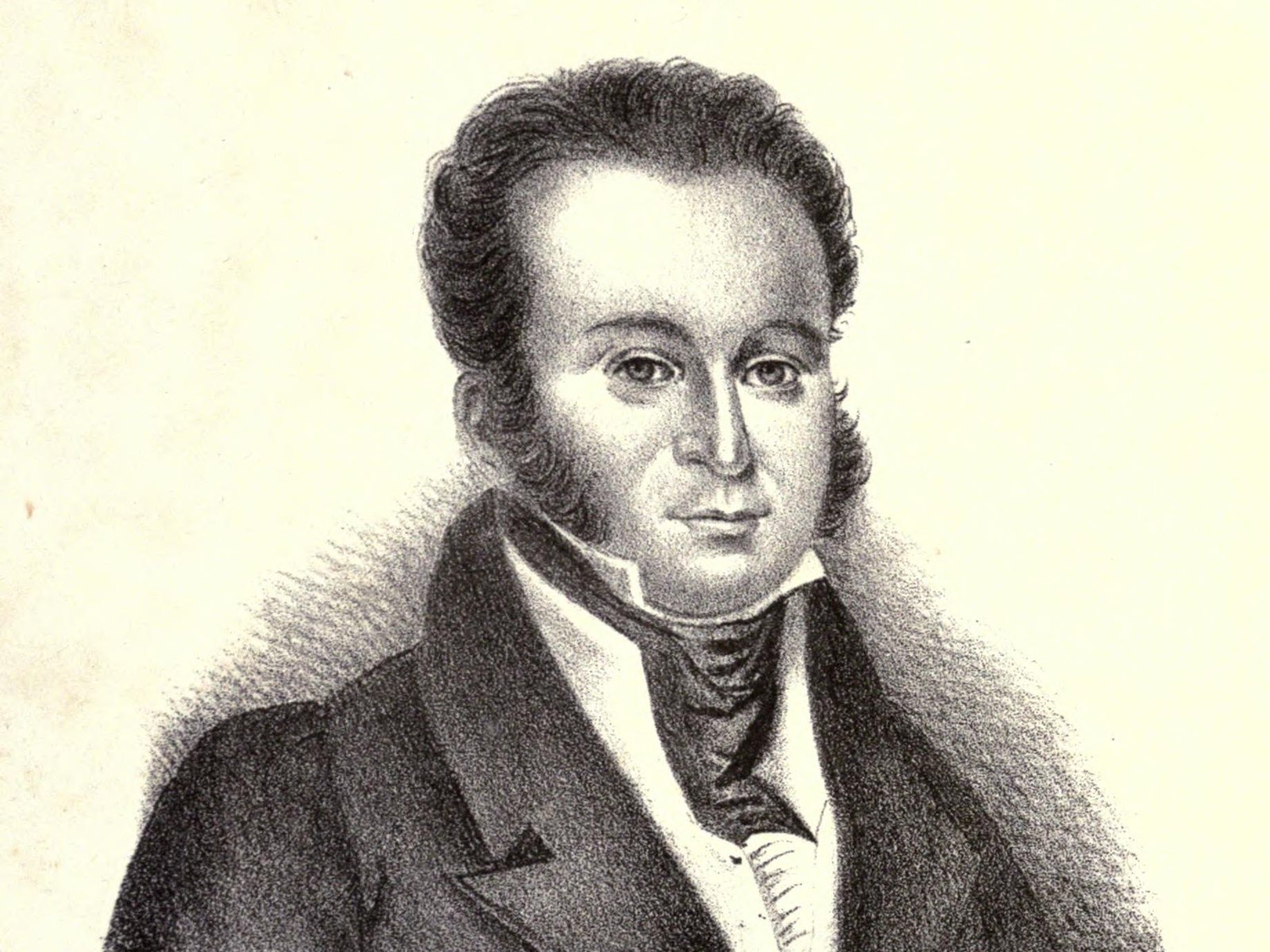
One of the men at the center of that quarrel would sign the Texas Declaration of Independence. He was born on October 3, 1788, in the village of Tecoh near Mérida, in Yucatán, and his name was Lorenzo de Zavala.
Few men came to Texas with more experience of government. The Handbook’s account reads like three careers pressed into one. He founded newspapers in Mérida as a young man and was imprisoned for his democratic ideas in the fortress of San Juan de Ulúa, where he read enough medicine to practice it on his release and taught himself to read English. He sat in the Spanish Cortes, in both of Mexico’s constituent congresses, and in its Senate. He governed the State of Mexico, served as secretary of the treasury in 1829, and went into exile in 1830 when his party fell. And he wrote the history of it all, the two-volume Ensayo histórico de las revoluciones de México, published in Paris and New York in 1831 and 1832. That history is where his Masonry lives, in his own words.
In 1825, Zavala writes, a group of federalists “formed the project of creating York lodges in opposition to the Scottish ones” that were working, as he saw it, to govern the country. President Guadalupe Victoria joined the project; his treasury secretary, José Ignacio Esteva, became its chief. “Each one had his own aims in that establishment,” Zavala adds; “the one who writes this was invited, and entered without any design.” Five lodges were formed, and the American minister, Joel Poinsett, was asked to obtain through his friends the regular charters from the grand lodges of the United States.
What followed, Zavala did not pretend was innocent. The number of York lodges “reached one hundred thirty”; they were opened in every state, and “the door was opened to the people, who entered with fanaticism.” At first the meetings were confined to “ceremonies of the rite” and “works of charity.” Then they became something else. “Elections, bills, the resolutions of the cabinet, the placing of officeholders, everything was treated in the grand lodge,” where deputies, ministers, senators, generals, clergy, governors, and merchants gathered. “What could resist a resolution taken in such a society?”
These are Zavala’s own words, in translation, and a memoir is always its author’s best witness. He says he entered without design; he also calls himself, in his second volume, “one of the principal directors among the yorkinos.” He helped build the machine. That is the hard page in this story, and it is the page that gives the rest its weight.
By 1827 the machine had turned on the Spaniards still living in Mexico. The demand to expel them ran through the lodges and the legislatures, and Zavala, by then governor of the State of Mexico, broke with his own side. “Although one of the principal directors among the yorkinos,” he writes, “I opposed the projects of expulsion” and sent a circular against the measure to the state legislatures. It would, he argued, break the promises of the Plan of Iguala and the Treaty of Córdoba and the guarantees of the constitution, and “punish, in every Spanish father of a family, five or six Mexicans.”
“Who would believe,” he asks, “that my circular would be the beginning of my great misfortunes and persecutions? The grand Lodge called me into its bosom to make severe charges against me,” for defending men who were themselves waging a personal war against him. His answer is printed in italics on page 27 of the second volume. He told them that he could not enter “into leagues or parties in which an injustice was intended; that there is no liberty where principles are not respected.”
A grand lodge had summoned a brother to account, not for a breach of the Craft, but for a vote. That is the whole disease in a single scene.
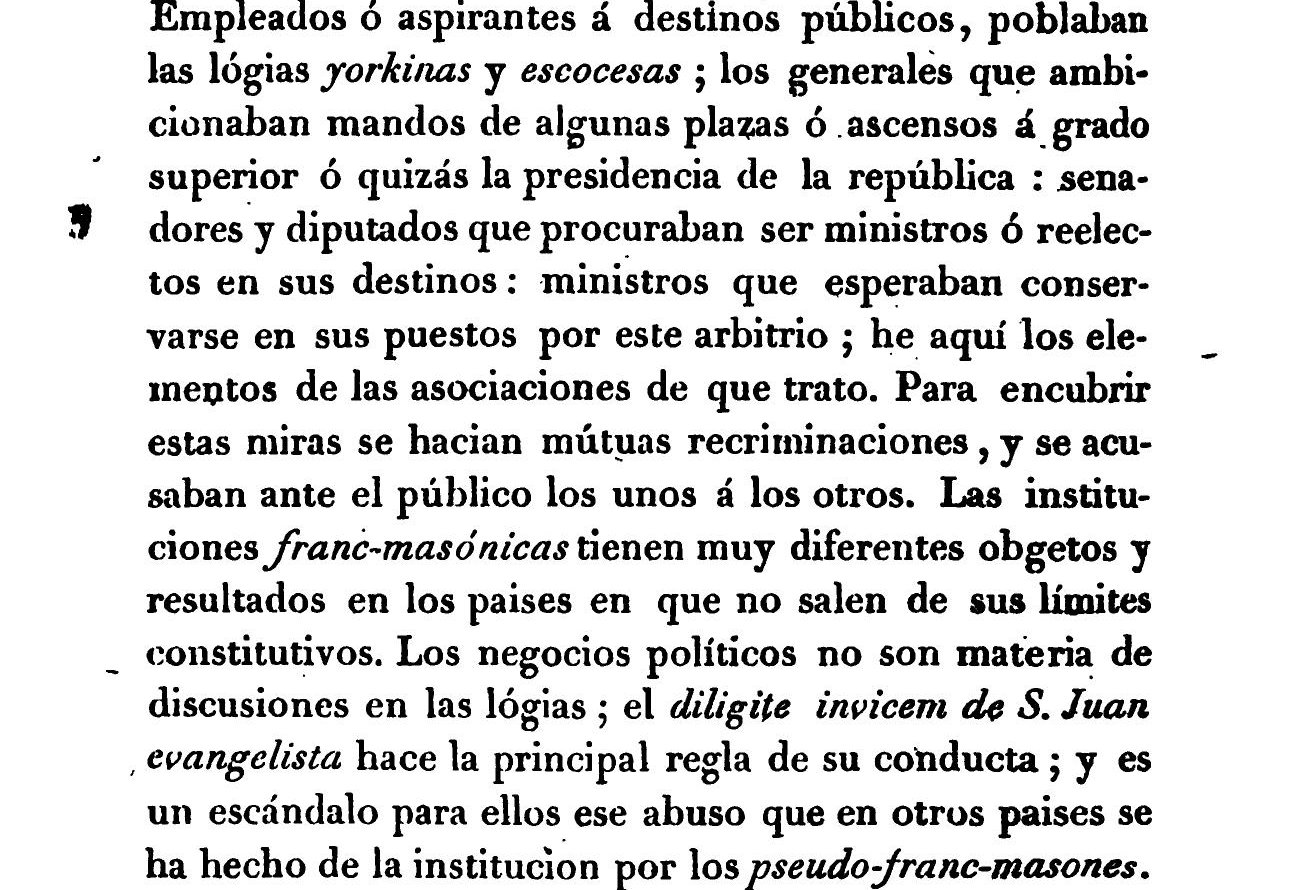
When he came to describe the lodges of 1826 in his history, Zavala set down the cure. Office-seekers, he wrote, had filled the York and the Scottish lodges alike. But “Freemasonic institutions have very different objects and results in the countries where they do not go beyond their constitutive limits. Political business is not a matter for discussion in the lodges; the diligite invicem of St. John the Evangelist is the principal rule of their conduct; and it is a scandal to them, that abuse which has been made of the institution in other countries by pseudo-freemasons.” Diligite invicem: love one another, the command that tradition remembers the aged apostle repeating to the end, and a saint whose name the Craft, by long tradition, keeps on its lodges.
He was not inventing the rule. The Constitutions that the premier Grand Lodge in London published in 1723 had already charged every Mason to keep quarrels about religion, nations, and state policy outside the lodge door, and declared the Craft “resolv’d against all Politicks, as what never yet conduc’d to the Welfare of the Lodge, nor ever will.” Zavala learned what that sentence costs when a lodge forgets it.
The rest of his life belongs to Texas, and it was short. In 1829 he received an empresario grant for five hundred families in what is now southeastern Texas. Sent to Paris in 1834 as Mexico’s first minister there, he resigned when Santa Anna seized dictatorial power, and in July 1835 he arrived in Texas. He sat for Harrisburg in the Consultation and the Convention of 1836, signed the Declaration of Independence alongside José Antonio Navarro and José Francisco Ruiz, and lent his long experience to the drafting of the constitution. The delegates elected him ad interim vice president. His health failing, he resigned the vice presidency on October 17, 1836. A few weeks later his rowboat overturned in Buffalo Bayou in a norther; he took pneumonia and died on November 15, 1836. He was buried at his home on the bayou, in a plot the water has since claimed. His granddaughter Adina De Zavala would be remembered for her fight to preserve the Alamo.
The Handbook’s entry on Freemasonry notes that every president, vice president, and secretary of state of the Republic was a Mason. No record found for this feature places Zavala in a Texas lodge, and he died thirteen months before the Grand Lodge of the Republic was organized at Houston. His Masonry was Mexican. What he carried into the founding generation was not a lodge membership but a lesson, learned at a price.
Johnson City Lodge No. 561 received its charter from the Grand Lodge of Texas on December 16, 1882. We meet in a county seat, in a country that argues about everything, and the brothers who sit in our lodge vote differently, worship differently, and read different newspapers. We can sit together because of a rule older than Texas that the Craft has never stopped repeating: whatever divides us in the street stays outside the door. It is easy to mistake that rule for politeness. Zavala knew better. He had seen a hundred and thirty lodges become a party, and a Grand Lodge summon a brother to answer for his conscience. Love one another, he wrote, is the principal rule. Guard the door, and the lodge can keep it.
Listen to This Story
6:02Read it here. Hear it anywhere.
Take the Story With You
Never miss a week.
Subscribe once and each new Texas Masonic history episode will arrive automatically in your podcast app.